

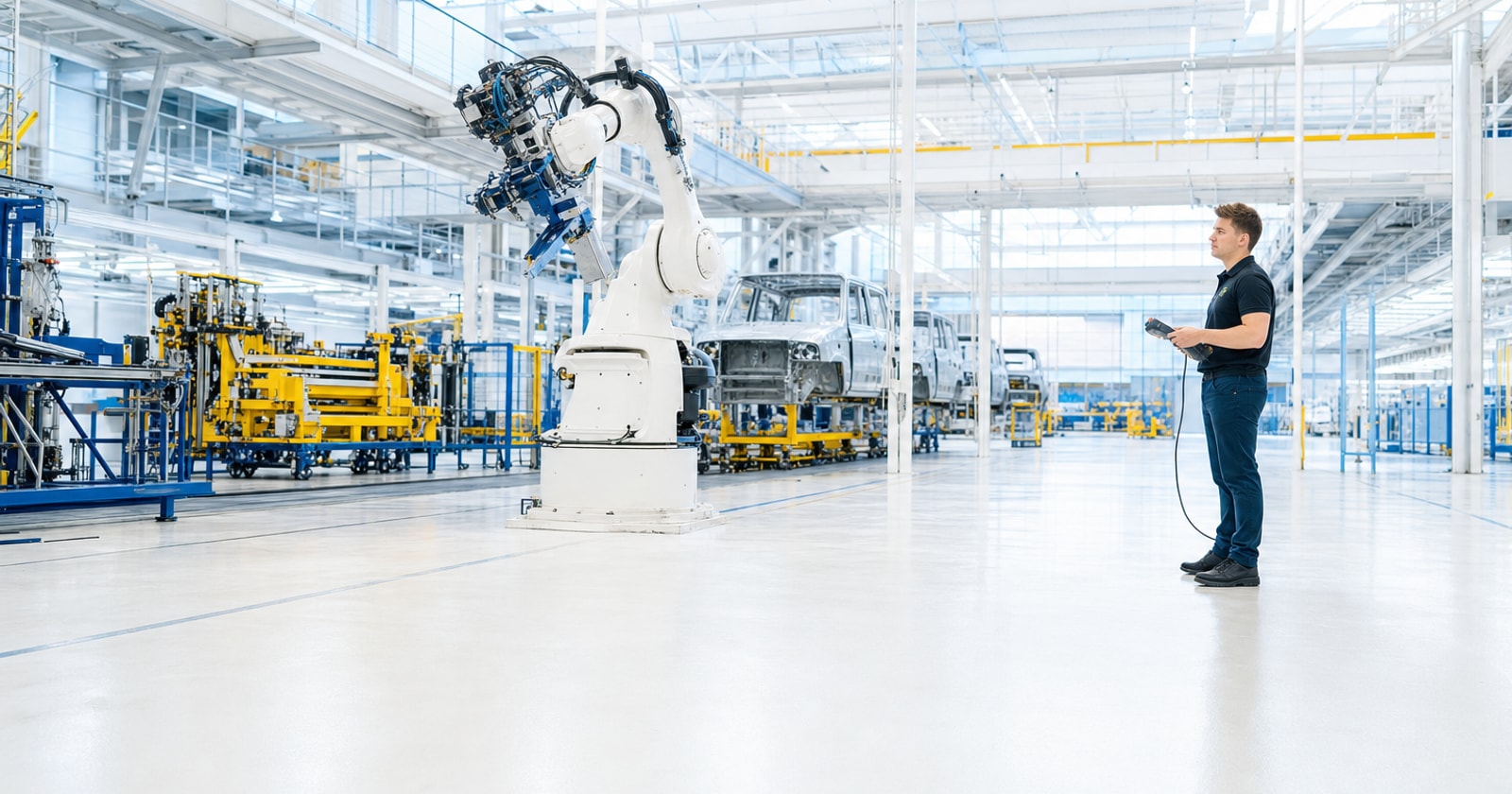
Physical AI just moved from a research paper to a running production line. Here is what that shift means if you run a field service or project business today.
Finding and keeping skilled tradespeople is the constraint that governs almost every growth conversation for HVAC, electrical, mechanical, and facilities contractors right now. You win a project, then spend three weeks figuring out who is going to do it without pulling crew off existing service agreements. You have the work. You cannot always find the hands. That tension sits at the center of nearly every operations meeting in the trades, and it is not going away on its own.
Which is why a funding announcement out of Cambridge, Massachusetts on July 15, 2026 is worth paying attention to, even if robotics feels like a world away from your dispatch board.
The News: Walden Robotics Comes Out of Stealth
Walden Robotics, a company spun out of Toyota Research Institute, emerged from stealth on July 15, 2026 with $300 million in seed funding and a reported valuation of $1.1 billion. The round was co led by Toyota and Deviation Capital, with participation from NVIDIA, Boeing, Samsung Ventures, and CoreWeave Ventures.
The company builds general purpose humanoid robots powered by what it calls Large Behavior Models (LBMs), a class of AI that learns from real world physical experience and keeps improving through continued practice on the job. These are not fixed function assembly robots designed to do one thing in one place. They are designed to adapt.
What makes this announcement operationally interesting rather than just financially large: Walden's robots have already been deployed in live production at a Toyota manufacturing plant in North America, and they went from pilot to live operations in under two months. That is not a lab demo. That is a robot doing real work inside a real production environment on a timeline that would have seemed implausible two years ago.
The investors in this round are not passive. Toyota has a direct operational interest. NVIDIA's involvement signals deep compute infrastructure at the foundation. Boeing and Samsung Ventures bring aerospace and electronics manufacturing context. This is a serious group of industrial operators and infrastructure builders treating this as real, near term production technology.
Why This Is Worth a Contractor's Attention Right Now
The immediate application is manufacturing, not field service. A Toyota plant and an HVAC service route are genuinely different operating environments. But there are a few signals here that contractors should not ignore.
Ramp Time Is the Metric That Changed
The fact that Walden went from pilot to live production in under two months is the headline that matters most from an operational standpoint. The traditional barrier to any new labor augmentation technology in the trades has always been the learning curve: the time and cost to get a new resource (human or otherwise) productive enough to be worth deploying on a real job.
A general purpose robot powered by a continuously learning model that can be operational in weeks changes the calculus on that barrier. It does not eliminate it, but it compresses it substantially.
Repetitive, Predictable, High Volume Tasks Are the Entry Point
Walden's robots are not going after complex judgment calls. They are going after repetitive, structured, high volume industrial tasks where the sequence of steps is predictable and the environment is reasonably controlled. In manufacturing, that is a wide surface area.
In field service and contracting, a version of that surface area exists too. Think about the repetitive installation tasks on a large mechanical or electrical project: running conduit through identical spaces across multiple floors, performing the same diagnostic sequence on a fleet of rooftop units, doing the same pipe prep work across dozens of units in a multi residential building. These are not tasks that require a journeyman's full judgment, but they consume journeyman hours because that is who is available and trained to be on site.
The Skilled Trade Gap Is Not Closing Fast Enough to Ignore Alternatives
In Ontario and across Canada, the gap between the skilled trades the industry needs and the ones entering the workforce is well documented and slow to close. Apprenticeship pipelines are improving but they take years. Immigration based workforce programs help but are not fast enough for contractors booking work two quarters out. Any technology that allows a skilled tradesperson to oversee and direct a larger volume of physical work, rather than doing every repetitive step themselves, is worth tracking.
A Practical Framework for Thinking About This
You do not need to make any decisions about robotics today. But you should be building the mental model now, because the contractors who understand where this is heading will be better positioned when it becomes a realistic option. Here is how to think about it.
Step 1: Audit your labor hours by task type. Pull your last three months of timesheets and work orders. Sort the hours into two buckets: tasks that genuinely require skilled trade judgment (troubleshooting, commissioning, anything with a permit and an inspection) versus tasks that are repetitive and procedural (prep, material movement, documented installation sequences). Most contractors who do this honestly find that a meaningful portion of skilled trade hours are going to the second bucket.
Step 2: Identify your highest cost repetitive tasks. Not just hours, but dollars. Where are you deploying journeymen on work that a well supervised apprentice could handle, or that a future robotic assistant might eventually handle? These are the positions in your operation that would benefit most from augmentation.
Step 3: Watch the ramp time and site portability metrics. The two questions that will determine whether general purpose robots ever reach field service are: how quickly can they be operational in a new environment, and how portable are they across different sites? Manufacturing plants are relatively controlled. Field sites are not. Watch how Walden and companies like it perform on those two dimensions over the next 18 to 36 months. That will tell you more than any product announcement.
Step 4: Start treating operational data as an asset. This is the step you can take right now. When robots and AI assisted labor tools do reach the trades, the contractors who benefit most will be the ones with clean, structured operational data: job costing by task type, time tracking at the activity level, project margin broken down by phase. Companies that are still running on disconnected tools and gut feel will not be able to quantify what augmentation is worth to them, or where to apply it first.
What This Means for Running a Mixed Service and Project Business
The mixed model contractor, the shop running both reactive service calls and planned projects simultaneously, faces a particular version of the labor constraint. Service demand is unpredictable. Projects are scheduled. Balancing crew across both without double booking, without pulling a project crew to handle a burst of service calls, and without leaving project margin on the table when the work slows down, is genuinely hard.
Any labor augmentation technology, whether it is better AI scheduling, apprenticeship programs, or eventually robotic assistance on predictable tasks, only creates value if your operations can absorb and direct that extra capacity efficiently. That means your dispatch, your work orders, your project tracking, and your job costing all need to be talking to each other in real time. If they are not, you add capacity and you add chaos.
This is precisely the gap that PolarPath was built to close for field service and project contractors in the 20 to 300 employee range. The platform connects sales, quoting, dispatch, field execution, project management, and invoicing in one continuous workflow, sitting alongside QuickBooks rather than replacing it. When your operational execution layer is coherent, you can actually see where your skilled trade hours are going, which tasks are consuming margin they should not be, and where new capacity, human or otherwise, would create the most value. That visibility is not optional for the shops that plan to grow in an environment where labor is the binding constraint.
The Practical Takeaway
Walden Robotics coming out of stealth with serious industrial partners and a live deployment at Toyota is not a reason for contractors to call a robotics vendor tomorrow. It is a reason to take the labor constraint seriously as a structural challenge, not just a hiring problem, and to start building the operational foundation that would let you act quickly when practical tools do reach your industry.
Clean data, connected workflows, and honest visibility into where your skilled trade hours are actually going, those are the table stakes. Build those now, and you will be in position to evaluate what comes next from a position of knowledge rather than scrambling.
The story is early. But the direction is clear.