
Operational Truth on the Job Site: How Field Teams Capture the Real Business Event (Before the Office Has to Guess)
There is a version of every job that exists in the office system, and there is a version that actually happened in the field. The gap between those two versions is where contractors lose money.
A tech replaces a secondary heat exchanger that wasn't on the original work order. He notes it on a paper form, or texts the dispatcher, or figures he'll mention it at the end of the day. The office closes the work order at the original scope. The change order never gets written. The part gets absorbed into job cost. Nobody is dishonest. The system just didn't capture the real business event when it happened. That's the operational truth problem.
What "Operational Truth" Actually Means
Operational truth is simple in concept: the record of what happened on a job matches what actually happened on a job, captured at the moment it happened, by the person who was there.
It sounds obvious. It's surprisingly rare.
Most field service businesses run on a version of the same architecture: a dispatcher creates a work order, a tech receives it (on paper, by phone, or through a basic app), does the work, and then information travels backward through a chain of humans before it becomes a record. Someone at the office transcribes the paper timesheet. Someone deciphers the tech's notes to write the invoice. A project manager follows up with the site to find out whether the inspection passed.
Every one of those handoffs is a place where the real event gets diluted, delayed, or lost. The office isn't making decisions based on what happened. They're making decisions based on what they were told happened, filtered through time and interpretation.
For a reactive service call, that lag might cost you one unbilled line item. For a project running over several months, it can compound into a margin bleed that only becomes visible at close out, when there's nothing left to do about it.
The Three Things That Define a Real Business Event
When a tech is on site, there are three types of information that have direct business consequences if they aren't captured accurately and immediately.
1. Time
Time is labor cost and, in most billing models, revenue. When time is captured at the end of the day by memory, it drifts. Start times get rounded. Drive time gets forgotten or inflated. Overtime gets missed on the timesheet and then flagged by payroll two weeks later.
On a project with multiple trades working overlapping scopes, inaccurate time reporting makes it impossible to know whether you're tracking to budget until it's too late.
Accurate time capture means: clock in and out on site, tied to the work order or project task, at the moment it happens. Not a paper timesheet filled in the truck on the way home.
2. Status
"How did the job go?" is a question that should have a structured answer, not a verbal debrief.
Status isn't just complete or incomplete. It includes:
- What was done and what was deferred (and why)
- Whether additional materials or a follow up visit are required
- Whether the customer signed off
- Whether a permit inspection passed or was flagged
- Whether anything was found on site that changes the scope
Each of these is a business event. A deferred task is a future work order. A failed inspection is a schedule risk. An out of scope finding is the beginning of a change order conversation, if someone captures it before the tech drives away.
When status lives in the tech's head until the next morning's debrief, the office is flying blind for the intervening hours. On a busy day with twelve service calls, that debrief never fully happens. Items fall through.
3. Photos
Photos are proof. They're also the fastest way to transfer context from the field to the office without a phone call.
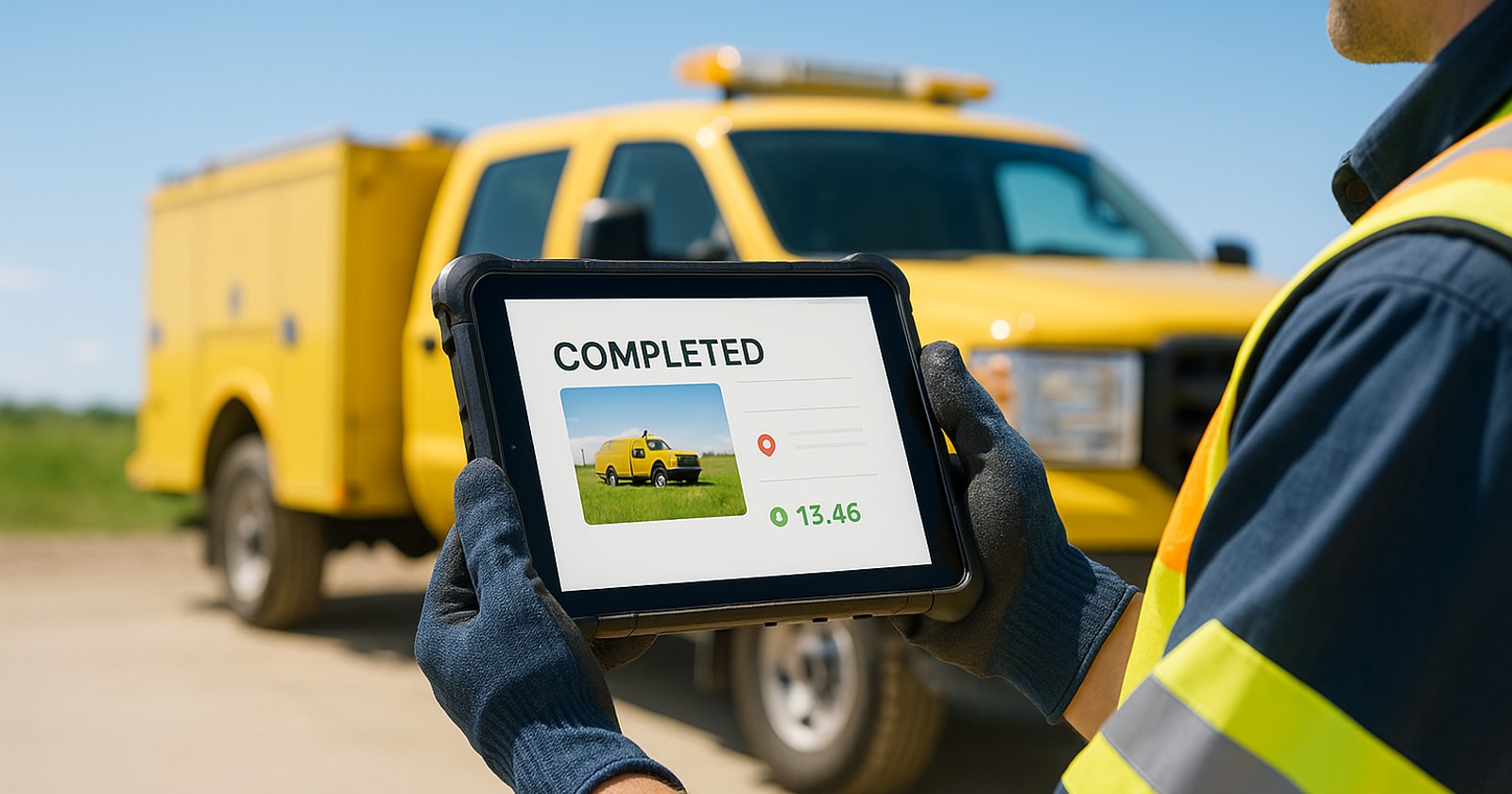
A photo of the equipment tag is the serial number for the service record. A photo of the completed installation is the documentation for the warranty. A photo of the pre existing damage is protection against a callback dispute. A photo of the unsafe condition found on site is the paper trail that justifies the additional scope.
Photos taken on site, attached to the work order in the moment, are operational truth. Photos texted to a group chat, or sitting in a phone camera roll, are operational noise.
Why This Matters for Mixed Model Contractors Especially
Contractors who run both reactive service and planned projects face a particular challenge: the information standards are different, but the field team is often the same people.
On the service side, speed is the priority. A tech who takes twenty minutes to document a two hour call is a tech who misses the next call.
On the project side, documentation is the product. A daily report, a photo log, an RFI response, a change order with supporting notes: these are what protect margin and enable billing. Sloppy field documentation on a multi month mechanical project doesn't just create a bad record. It creates unbillable work, disputed invoices, and schedule disputes with the GC.
The operational truth standard has to hold in both modes. That means the capture process has to be fast enough for service work and thorough enough for project work, and the tech can't be responsible for knowing which mode they're in on a given day.
A Practical Framework: The Five Minute Close
One way to build better field capture habits without adding administrative burden is the five minute close: a structured completion step that happens before the tech leaves the site, tied to the work order itself.
It covers five things:
- Time confirmed. Clock out on the work order. Flag any overtime or split shift conditions.
- Status set. Mark the work order complete, partially complete, or deferred, with a required note if it's anything other than complete.
- Photos attached. Minimum one photo of completed work. Required photos for equipment installs, inspections, or anything out of scope.
- Materials noted. Any parts used that weren't on the original work order are flagged as potential additional billing.
- Customer acknowledgment. Digital sign off or a note explaining why it wasn't obtained.
This isn't a new concept. The discipline is in making it happen at the work order level, not as a separate form, not as a memory exercise at the end of the day.
When the five minute close is built into the work order workflow, the office gets real data, in real time, without a phone call. Dispatch knows the job is actually done. Finance knows what to bill. The project manager knows whether the inspection passed.
What Happens When You Have Operational Truth
The downstream effects of accurate, timely field capture are significant and concrete.
Invoicing accelerates. When the work order closes with confirmed time, materials, and sign off, the invoice can be generated from that data directly. No one is waiting for the tech's timesheet. No one is guessing whether to bill for the extra half hour.
Change orders get written. When an out of scope finding is captured on site with a photo and a note, it becomes a change order conversation that evening. When it lives in the tech's memory, it becomes a discussion about whether the work was authorized, three weeks later, after the invoice goes out.
Job cost is visible in real time. When time and materials are captured against the work order or project task as they occur, the project manager can see margin at any point during execution, not just at close out.
Callbacks get defended or prevented. Photo documentation of completed work is the fastest way to resolve a callback dispute. It's also the fastest way to identify a pattern: if three separate techs are returning to the same equipment type within thirty days, the photos tell you why.
The Technology Should Enable the Discipline, Not Create It
It's worth being direct here: no software solves a culture where field documentation isn't valued. If your techs don't understand why the five minute close matters, an app won't change that.
But the right platform removes the friction that makes good habits hard to sustain. When time, status, photos, and materials are captured in the same place where the work order lives, and that data flows directly into invoicing and project tracking without re keying, the discipline becomes the path of least resistance instead of the extra step.
PolarPath is built around this idea. The operational execution layer, from the moment a work order is dispatched through field capture, invoicing, and project margin visibility, sits in one continuous workflow. QuickBooks stays the accounting system of record. PolarPath is where the business events actually happen and get captured.
Takeaway
The gap between what the field did and what the office knows is where contractor margin goes. Closing that gap doesn't require a large investment in training or technology. It requires a defined capture standard (what gets recorded, when, by whom), applied consistently at the work order level.
Build the five minute close into your field workflow. Make photos non optional for scope changes and equipment installs. Tie time to the work order, not the timesheet. Do that, and the office stops guessing.
If you want to see how PolarPath handles the operational execution layer for mixed model contractors, book a walkthrough at polarpath.ca.