

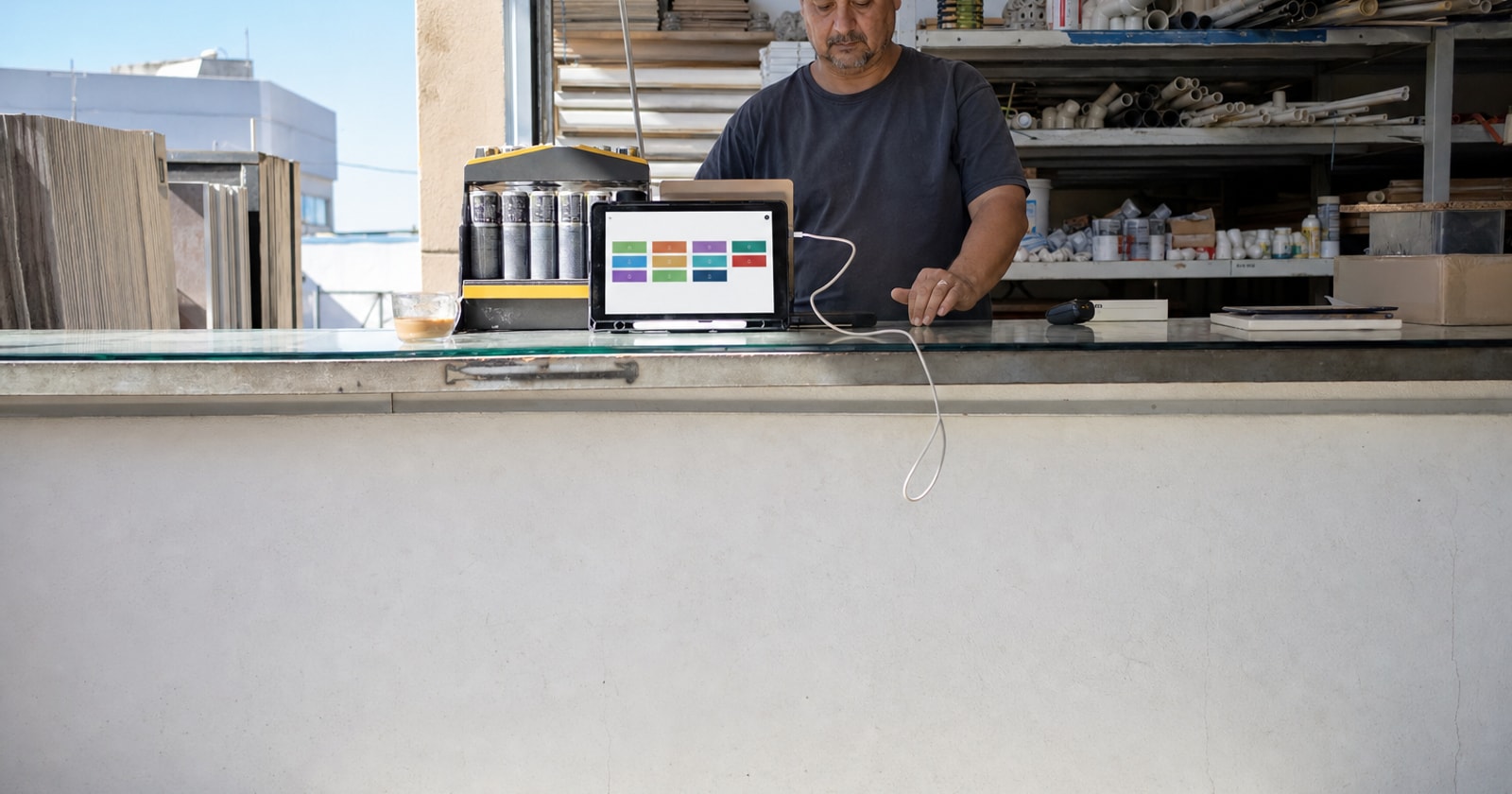
Rundoo just raised $30 million. That matters to contractors, not because they sell paint or pipe fittings, but because of why the model is working.
Most field service and trade businesses run on a stack of tools that were never designed to talk to each other. A CRM here, a dispatch board there, a project management app the PM swears by, QuickBooks for the books, and a spreadsheet the owner built three years ago that everyone is afraid to touch. The "integration" between them is people re keying data and chasing handoffs by text message. That is expensive, invisible, and slow, and the cost usually shows up as a change order nobody billed, a job that closed at a margin nobody expected, or a crew that showed up somewhere twice.
The news out of the distribution sector this week puts a useful frame on this problem.
What Rundoo Actually Built, and Why It Resonates
SiliconANGLE reported on August 19, 2026 that Rundoo, a Redwood City, California based startup founded in 2021, closed a $30 million Series B led by Battery Ventures, with Bessemer Venture Partners and CRV participating. Total funding now sits at $48 million. The platform is in use at more than 500 independent supply stores across the U.S., Canada, and the Caribbean.
Rundoo built a single system of record for independent supply stores: point of sale, e commerce, CRM, loyalty programs, and general ledger, all in one place. Central to that platform is an AI agent called Dooey, which helps store owners analyze sales data, generate purchase orders based on historical trends and weather, and execute customer outreach, without switching between five different tools to do it.
The pitch is not "here is another app." It is: here is one place where operational truth lives, and here is an AI layer that can act on that truth because it has context from the whole business.
That is a meaningful distinction. And it is exactly the distinction field service and project contractors have been waiting for in their own market.
The Parallel That Should Get Your Attention
Rundoo's customers are independent operators running complex, relationship driven businesses with thin margins, irregular demand, and a mix of transactional and longer cycle work. Sound familiar?
HVAC, electrical, mechanical, and facilities contractors face the same structural problem at a different scale. You have reactive service calls (transactional, urgent, dispatched same day) running alongside planned projects (multi week, multi crew, budgeted, with change orders and milestone invoicing). The tools that serve one side of that business rarely serve the other. And even when they do, the data does not travel.
Here is what that looks like in practice:
- A tech closes a service call and notes that the customer's rooftop unit is near end of life. That information lives in the field app. The sales team does not see it.
- A change order gets approved on site. The project manager knows. The billing team does not.
- A crew finishes a job. Hours are on the timesheet. The invoice goes out five days later because someone has to manually reconcile field notes, materials, and labour before touching QuickBooks.
- A permit is pulled for a project. Nobody is tracking its expiry. Six weeks later, the inspector shows up and the permit lapsed.
Each of these is a small gap. Cumulatively, they are margin erosion, delayed cash flow, and operational drag that compounds daily.
The Framework: What "One Source of Operational Truth" Actually Means
Rundoo's model shows what happens when you build from the assumption that every business event, a sale, a purchase order, a customer interaction, should immediately be visible across the whole operation. Here is how to think about applying that same principle to a field service or project business:
1. Map where data dies between handoffs
Start with your quote to cash cycle. Where does information stop moving? Common dead zones: quote approved but not dispatched cleanly, field notes that never reach billing, change orders that live in email threads, labour actuals that never get reconciled against project budget.
2. Ask what decisions are being made with stale data
Your ops lead is scheduling tomorrow's crew based on what they know right now. Your controller is reconciling last week's invoices manually. Your PM is estimating project margin from memory. If the people making decisions are working from lagging or incomplete information, the decisions will be lagging and incomplete.
3. Identify which gaps are costing real money
Not all data gaps are equal. Prioritize the ones with a dollar value: unbilled change orders, invoices delayed past your payment terms, projects running over budget because actuals were not visible in time to course correct, service calls generating upsell opportunities that never got followed up.
4. Look for the layer that connects field to finance
This is the operational execution layer: the place where work orders, timesheets, field notes, expenses, and change orders all live, and from which invoices and payroll exports flow. If that layer is stitched together by humans copying data between tools, that is where the cost is hiding.
Where PolarPath Fits This Picture
PolarPath was built specifically for the mixed model contractor: the shop running both reactive service and planned projects, with 20 to 300 people, that has outgrown founder led coordination but is not ready (or willing) to go full enterprise ERP.
The platform covers the operational execution layer end to end: customer intake, quoting, dispatch, work orders, mobile field execution, project management with change orders and RFIs, permit tracking with expiry reminders, invoicing triggered from field data, timesheets, expenses, and payroll export. It coexists with QuickBooks; it does not try to replace the accounting system of record.
The Rundoo story is instructive because it shows what investors and independent operators alike are recognizing: vertical, context aware platforms beat tool stacks not because they have more features, but because data continuity across the business is itself the product. When a change order approval in the field immediately shows up in the project margin view and queues an invoice, no one has to chase the handoff.
That is the same problem PolarPath was built to solve, one job at a time, for the trades.
The Practical Takeaway
You do not need a $48 million platform to start thinking about this clearly. Start with one question: in your business right now, where does a business event happen, work approved, materials used, hours logged, and how many hours or days pass before that event is reflected in a number someone is managing?
That gap is your baseline. Shrinking it is how margin and cash flow improve. The tool architecture that enables it is a platform question, not a feature question.
If you want to see how that looks for a field service and project business specifically, polarpath.ca is a reasonable next step.