

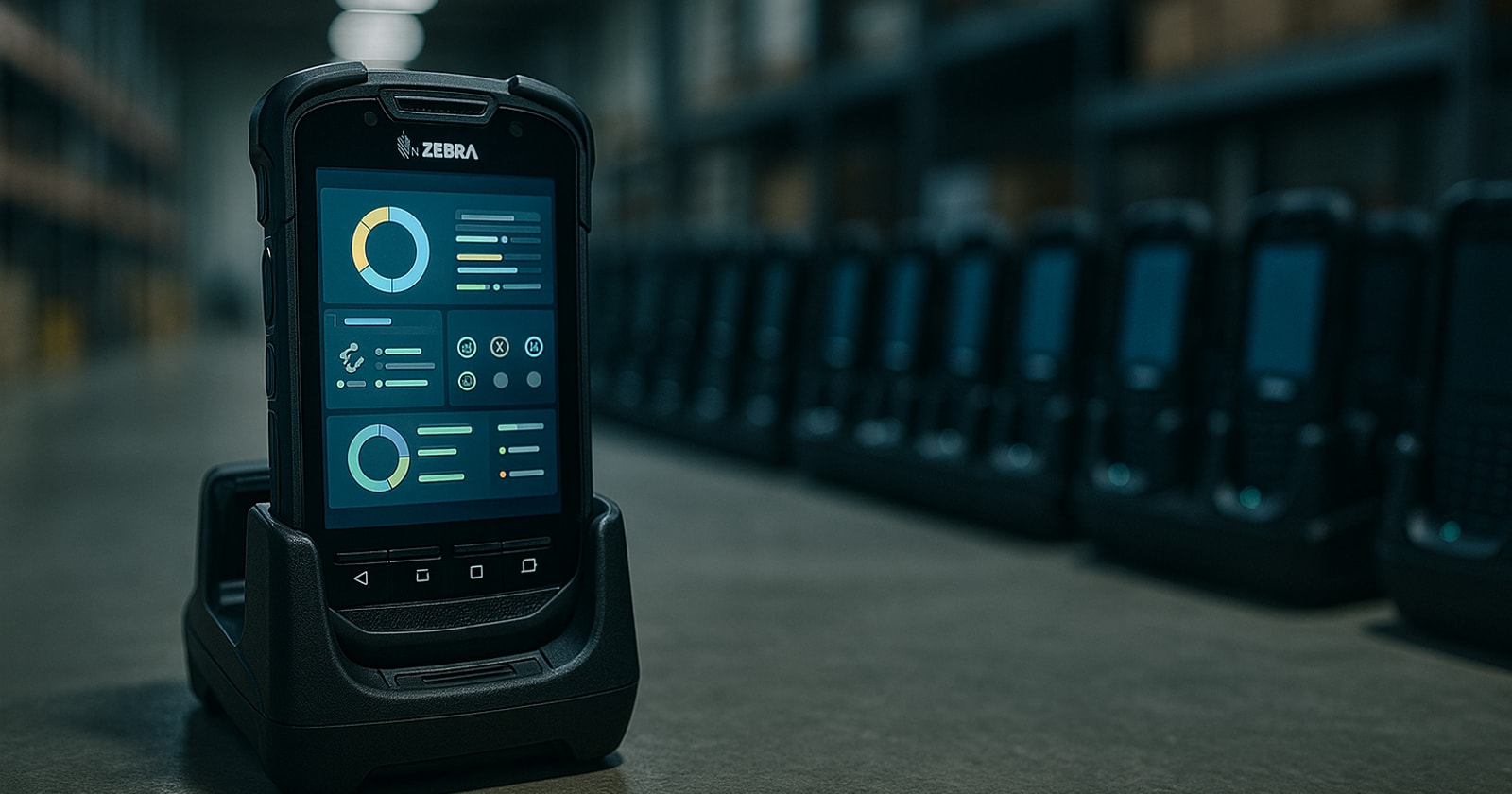
At its annual ZONE 2026 customer conference in Nashville, Zebra Technologies announced two new software platforms designed to address a problem that anyone running a field operation will recognize immediately: too many tools, too little visibility, and too much time spent on admin that should never have existed in the first place.
Zebra's announcements included Zebra Nucleus, which consolidates device setup, security, management, and optimization into a single unified interface across Zebra's full product portfolio, and Zebra Workcloud Business Intelligence, which delivers AI powered, role based mobile dashboards for real time frontline visibility. A third piece, Workcloud Integration and Orchestration, connects those Workcloud solutions to core business systems, like point of sale, to coordinate workflows across the enterprise.
These are enterprise scale tools aimed at large organizations managing large fleets of mobile devices and frontline workers. But the operational problem they are solving is not unique to Zebra's customer base. It is the same problem every HVAC, electrical, mechanical, and facilities contractor faces the moment their team grows past the point where one person can hold everything in their head.
The Problem Has a Name: Coordination Debt
Every field service business accumulates coordination debt as it grows. In the early days, the owner knows every job, every crew member, and every open invoice. The "system" is one person's memory plus a whiteboard. It works, until it doesn't.
The moment you have more than a handful of crews running both reactive service calls and planned projects, coordination debt starts accruing interest. It shows up as:
- A change order that got approved on site but never made it back to the office to be billed.
- A permit expiry that nobody caught because the reminder was buried in someone's email.
- A crew double booked because dispatch was working from a spreadsheet while the project manager was working from a different one.
- A job that closed field complete weeks before the invoice went out, because the billing team was waiting on paperwork that was sitting in a van.
None of these are catastrophic on their own. Together, they are a slow margin leak that is nearly impossible to see clearly when your operational data is scattered across four or five different tools.
Zebra's launches at ZONE 2026 are a direct response to this dynamic at the device fleet and workforce visibility layer. The insight behind Zebra Nucleus and Workcloud Business Intelligence is straightforward: when the tools your frontline workers use every day are managed and monitored in disconnected silos, the people who need to act on that information are always working from stale or incomplete data.
What "Real Time Frontline Visibility" Actually Means in a Field Operation
The phrase "real time visibility" gets thrown around a lot. It is worth unpacking what it actually looks like in a trade contracting context, because the mechanics matter.
The gap between field reality and office knowledge
In most shops running a mixed service and project model, there is a lag between what happens in the field and what the office knows. A tech closes a work order on a service call. That information might hit a dispatch board, a timesheet, a job costing sheet, and an invoicing queue, but those are often four separate systems. The office learns what happened on the job only when a human manually carries the information from one tool to the next.
That human middleware is where coordination debt compounds. It is slow. It is error prone. And it is invisible until something falls through the cracks.
Real time frontline visibility means collapsing that lag. It means a field manager can see, from a single dashboard, which jobs are in progress, which are stalled, which have open change orders, and which are at risk of going over budget, without making three phone calls and waiting for someone to update a spreadsheet.
Why role based dashboards matter
Zebra's Workcloud Business Intelligence delivers role based dashboards, and the "role based" part is not a minor detail. The information a dispatcher needs to see is not the same information a project manager needs, which is not the same information a finance controller needs to do their job.
When everyone is looking at the same flat report and filtering it themselves, the data becomes a job in itself. When the dashboard is structured around what each role actually needs to act on, the data becomes a decision support tool instead of a research project.
This is a useful design principle for any field service operation thinking about how to structure their own operational reporting, whether or not they are managing Zebra devices.
A Framework for Evaluating Operational Visibility in Your Shop
If the Zebra story resonates, it is worth doing a quick audit of where your own coordination debt is highest. Here is a simple framework:
1. Map your handoffs. List every point in your workflow where information moves from one person or system to another. Quote to dispatch. Dispatch to field. Field to billing. Billing to collections. Each handoff is a potential drop point.
2. Identify the lag. For each handoff, ask: how long does it typically take for the downstream person to receive accurate information? Hours is acceptable. Days is a problem. "It depends on whether someone remembered to update the system" is a symptom of coordination debt.
3. Find the unbilled work. Pull your last 90 days of closed jobs and ask: were there any change orders, extra materials, or after hours calls on those jobs that did not make it onto the final invoice? If the answer is yes (and in most shops it is), you have a visibility gap between field execution and billing.
4. Count your tools. List every tool your team uses to run the business from first customer contact through to payment collected. CRM, dispatch, project management, timesheets, expenses, invoicing, payroll. If that list has more than three or four entries and they do not share a common data layer, you are running on human middleware.
5. Ask your field leads what they cannot see. The people closest to the work usually know exactly where the gaps are. Ask a senior tech or a project manager: what information do you wish you had in the moment, that you currently have to call the office to get? Their answer will tell you where your visibility problem is sharpest.
Where Operational Platforms Fit
Zebra is solving a specific slice of this problem for large organizations: device fleet management and frontline worker visibility at scale. That is a real and important problem for the kinds of enterprises that deploy hundreds of ruggedized handhelds and need centralized control over all of them.
For trade contractors running 20 to 300 people on a mix of service and project work, the more pressing version of the same problem is process continuity across the full quote to cash and workforce chain. The question is not just "where are my devices" but "where is the job, where is the money, and where are the people, all in one place."
That is the problem an operational platform like PolarPath is built for. PolarPath sits on top of, and works alongside, QuickBooks rather than replacing it. It owns the execution layer where business events actually happen: quotes, dispatch, field work orders, project tracking, change orders, timesheets, invoicing, and workforce management. The accounting system of record stays where it is. The operational data that feeds it gets clean, continuous, and visible for the first time.
The integration and orchestration piece Zebra is building for its enterprise customers is exactly what a field service operator needs between their service workflow and their project workflow, between the field and the back office, between completed work and collected cash.
The Practical Takeaway
Zebra's ZONE 2026 announcements are a useful signal for any operations focused business. The direction the market is moving, from scattered point tools toward unified platforms that deliver role specific, real time data, reflects a real operational need that is not going away.
You do not need to be managing a fleet of enterprise devices to ask the same question Zebra's customers are asking: how much coordination overhead could I eliminate if my tools shared a common view of what is actually happening in the field right now?
Start with the handoff audit above. Find the three or four places where information moves slowly or drops entirely. Fix those first, whether through process discipline, better tooling, or both. The goal is not a perfect system overnight. It is closing the gap between what your field teams know and what your office can act on, one handoff at a time.
If fragmented tools are quietly costing you billable work, it is worth a conversation. Book a walkthrough at polarpath.ca.