

Most contractors aren't losing margin because their crews can't lift panels or move materials. They're losing margin because no one caught the change order that never got priced, the invoice that sat in draft for nine days, or the permit that quietly expired while two crews waited on site. The physical work gets done. The coordination work is where money walks out the door.
That context matters a lot when you look at what a company called Gritt just announced, because the story isn't really about robots. It's about where skilled labor is actually going.
What Gritt Just Announced
Gritt emerged from stealth on July 21, 2026, with $32.4 million in combined pre seed and Series A funding. The $26 million Series A was led by Obvious Ventures, with participation from Union Square Ventures and Active Impact Investments.
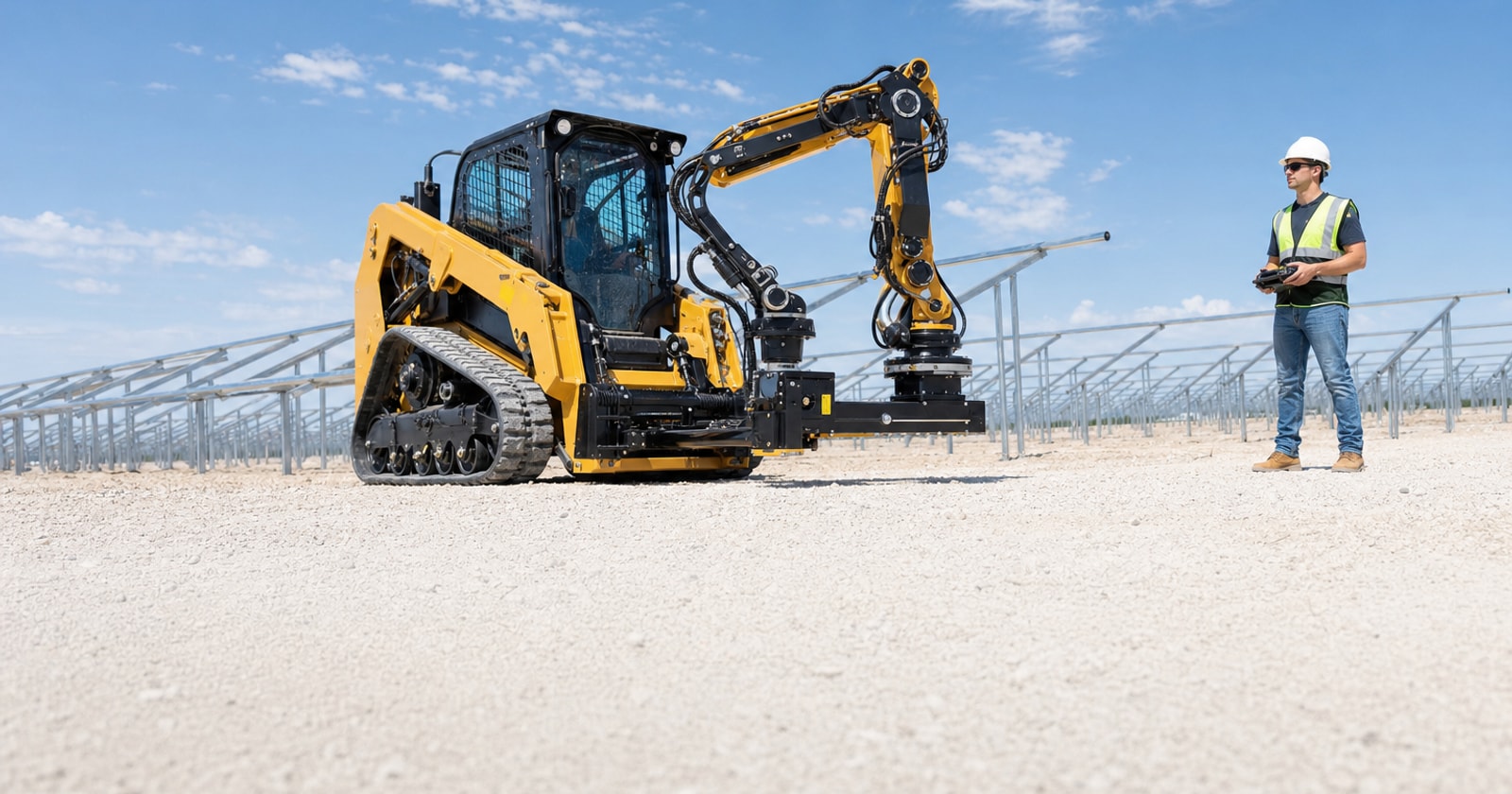
The product is straightforward in concept: AI powered robotic arms that attach to equipment jobsite crews already own, like skid steers and forklifts. These systems enable automated pick and place, assembly, and material transport with millimeter level precision. Gritt is starting with large scale solar farm construction and has plans to expand into data center builds and other major infrastructure projects.
The approach that stands out is the retrofit model. Rather than replacing the equipment or the crews, Gritt bolts intelligence onto what's already there. That's a meaningful signal. It means the friction isn't in the adoption of new hardware, it's in how you operate once the physical layer starts running itself.
Why This Matters for Field Service and Project Contractors
The contractors most likely to feel this shift first aren't necessarily the ones building solar farms. They're the mechanical, electrical, and facilities contractors who work on those projects as subcontractors, or who run their own mixed portfolios of service calls and planned projects across the GTA and broader Ontario market.
Here's the operational logic: if robotic systems start handling the most labor intensive repetitive field tasks, the crew composition on a job changes. You have fewer people doing manual material handling and more people doing the work that actually requires a license, a judgment call, or a site level decision. That sounds like a win. It is, if your back office can keep up.
The challenge is that most field service businesses have built their coordination workflows around the assumption that a tradesperson's time is mostly consumed by physical work. Scheduling, dispatch, timesheet approval, change orders, site communications, and invoicing are all batched around that reality. When the physical work accelerates, those coordination workflows become the bottleneck. And most of those workflows today run on a combination of texts, spreadsheets, and whoever remembers to follow up.
The Three Operational Gaps That Get Exposed
When physical capacity on a jobsite increases, whether through more efficient crews or robotic augmentation, three coordination gaps tend to surface first. These aren't hypothetical. They're the same gaps that show up today whenever a contractor scales a crew or takes on a bigger project mix.
1. Change Order Lag
More work happening faster means more scope changes surfacing faster. A change order that takes three days to write up, approve, and return to the office for billing is expensive when a project moves slowly. When the pace of physical work compresses, that lag becomes a margin problem almost overnight. Billable work piles up faster than the billing process can absorb it.
2. Permit and Compliance Exposure
Complex outdoor jobsites, especially in infrastructure, carry a lot of permit dependencies. The more tasks running in parallel, the easier it is for a permit expiry or a compliance gap to go unnoticed until a crew is already on site and waiting. That wait time is real cost.
3. Workforce Coordination Overhead
When skilled workers shift toward coordination and oversight roles, the scheduling picture gets more complicated. You need to know who is qualified for which oversight tasks, where they're deployed, and how their time maps to project budget. That's a different demand than scheduling a service call. Utilization tracking matters more. Double booking an oversight lead on two concurrent sites is a different kind of problem than a dispatch conflict on a service run.
How to Think About Your Own Operation Right Now
You don't need to be buying robotic arms to use this moment as a diagnostic. The question Gritt's announcement should prompt is: if your crew's physical output on a typical job doubled tomorrow, where would your operation break?
Work through this honestly:
- Quote to field handoff. If a project scaled faster than expected, how many days would pass between the scope change in the field and a revised quote in the client's hands?
- Change order to invoice. On your last three projects, how long between a change order being agreed on site and the invoice going out? Longer than a week is a margin leak.
- Permit status visibility. Who in your shop knows, right now, which permits are within 30 days of expiry across your active jobs? Is that answer immediate or does someone have to dig?
- Workforce scheduling depth. If you had to add a coordination layer to an existing job because physical tasks finished early, how quickly could dispatch re slot the right people without doubling someone up?
- Field to finance speed. When work is completed on site, how many manual steps stand between the technician closing out the work order and an invoice reaching the client?
These questions expose the same human middleware problem that exists today at normal pace. The only thing a more automated physical layer does is make the slowness of that middleware more visible.
The Practical Takeaway
Gritt's bet is that you augment what crews already have rather than replace them. That's a sensible path for physical work. The equivalent principle on the operational side is the same: you don't throw out your QuickBooks, your dispatcher's institutional knowledge, or your project manager's relationship with a site super. You give those people a continuous operational layer where information flows without re keying.
That's the infrastructure that makes a faster physical jobsite actually pay off. When a technician closes a work order in the field and it flows directly to invoicing, when a change order gets logged and priced from the same mobile interface the crew is already using, when permit expiry triggers a reminder before someone drives 90 minutes to a site that's not ready, the skilled labor doing coordination work can actually do it well, rather than spending their day chasing down what happened.
Gritt is solving for the physical layer of a jobsite. What they're surfacing, for contractors paying attention, is that the operational layer needs to be just as solid. That's the conversation PolarPath is built for: how does a field service or project business run the coordination, billing, and workforce side without the whole thing depending on a handful of people who happen to remember everything?
The tools are coming for the physical work. The question is whether the business side is ready to keep up.
Source: Unite.AI, July 21 2026