

You ask your dispatcher how many crews are available Thursday. They check one system. You ask your project manager what the Scarborough mechanical job is costing against budget. They open a spreadsheet. You ask your controller whether the change orders from last week have been invoiced. She checks her email.
Three questions. Three different places. And not one of them fully trusts the answer they're giving you, because the data upstream from them might have changed since they last looked.
This is not a technology problem. It is an operational continuity problem, and it costs real money every single week.
The Actual Cost of a Disconnected Operation
Most contractors who have grown past the founder doing everything stage already know their tools are misaligned. They just haven't named what it costs them.
Here is what the gap between systems actually produces:
- Unbilled change orders. A tech completes extra work on site. It gets logged in the field app, noted on paper, or remembered. It does not automatically become a line item on an invoice unless someone catches it, and someone is busy.
- Margin that evaporates between quote and close. A project is quoted, won, and handed off. But the PM now builds their own cost tracking in a spreadsheet that has nothing to do with the original quote. By the time the job closes, nobody can say with certainty what the margin actually was versus what was promised.
- Dispatch conflicts nobody sees coming. A service ticket is booked the same day a crew is already committed to a project milestone. Both systems look correct from inside their own silo.
- Slow invoicing cycles. If the data lives in the field app and the invoice lives in QuickBooks, there is a human in the middle, re keying, reconciling, confirming. That human is the bottleneck. Days to invoice stretches. Cash flow tightens.
- Compliance gaps. A permit on a mechanical project expires. Nobody got the reminder because the permit tracking system, if one exists, is not talking to the project schedule.
None of these are catastrophic individually. Together, over a year, they are the difference between a business that is growing and one that is grinding.
What Operational Continuity Actually Means
The phrase sounds corporate, but the mechanic is simple: when something happens in one part of your business, the rest of your business knows about it automatically.
A customer calls in a service request. It becomes a work order. The work order is dispatched to the right tech based on availability, skills, and location. The tech completes the work, logs time and materials on mobile. That data flows directly into an invoice. The invoice goes to the customer. Payment is tracked.
At the same time, if that service call reveals a larger project scope, the quote is built from the same record. If the project is won, the project schedule, crew assignments, budget, and documents all live in the same place as the original service relationship.
That is the whole loop. And when any link in that loop is broken, when data has to be manually moved between systems, you do not just lose efficiency. You lose visibility. And when you lose visibility, you make slower decisions with worse information.
A Framework for Auditing Your Own Handoffs
Before buying anything, it is worth mapping where your handoffs actually break. Walk through a recent service call or project from start to finish and ask:
1. Where did someone re key data that already existed somewhere else?
Every re key is a delay and an error opportunity. Common examples: entering customer info from an email into a CRM, pulling quote line items into a work order manually, copying field notes into an invoice.
2. Where did someone have to ask another person for a status update?
If a question like "has this been invoiced?" or "is that crew available?" requires a conversation instead of a lookup, that is a visibility gap. Someone's time is being spent on an information transfer that should be automatic.
3. Where did something fall through the cracks in the last 90 days?
A change order that didn't get billed. A follow up quote that expired without a call. A tech who showed up at a job that wasn't ready. These are not people problems. They are handoff problems.
4. Where does your project margin actually get tracked?
Is it in the same place as your original quote? Is it updated in real time as POs and timesheets come in? Or is it reconciled manually at job close, when it's too late to course correct?
Most contractors who do this exercise find two or three places where the answer is uncomfortable. That is normal. It is also fixable.
What One Continuous Workflow Changes
When the operational layer is unified, when sales, dispatch, field execution, project tracking, invoicing, and workforce are all drawing from and writing to the same system of record, a few things happen that feel almost unfair compared to the old way.
Invoicing compresses. When field data flows directly into billable records, the lag between "work completed" and "invoice sent" shrinks to hours, not days.
Change orders get billed. Because the change order lives in the same workflow as the original scope, it cannot be forgotten. It is either approved and included or it is explicitly excluded. There is no third state where it disappears.
Project margin is visible in motion. Because POs, timesheets, and expenses post against the project budget as they happen, the PM can see margin drift before the job closes. That is when it can still be addressed.
Dispatch conflicts surface before they happen. Because crew availability, project commitments, and service tickets are all in the same view, the dispatcher can see the conflict at scheduling time, not on Thursday morning when two foremen call in asking who is going where.
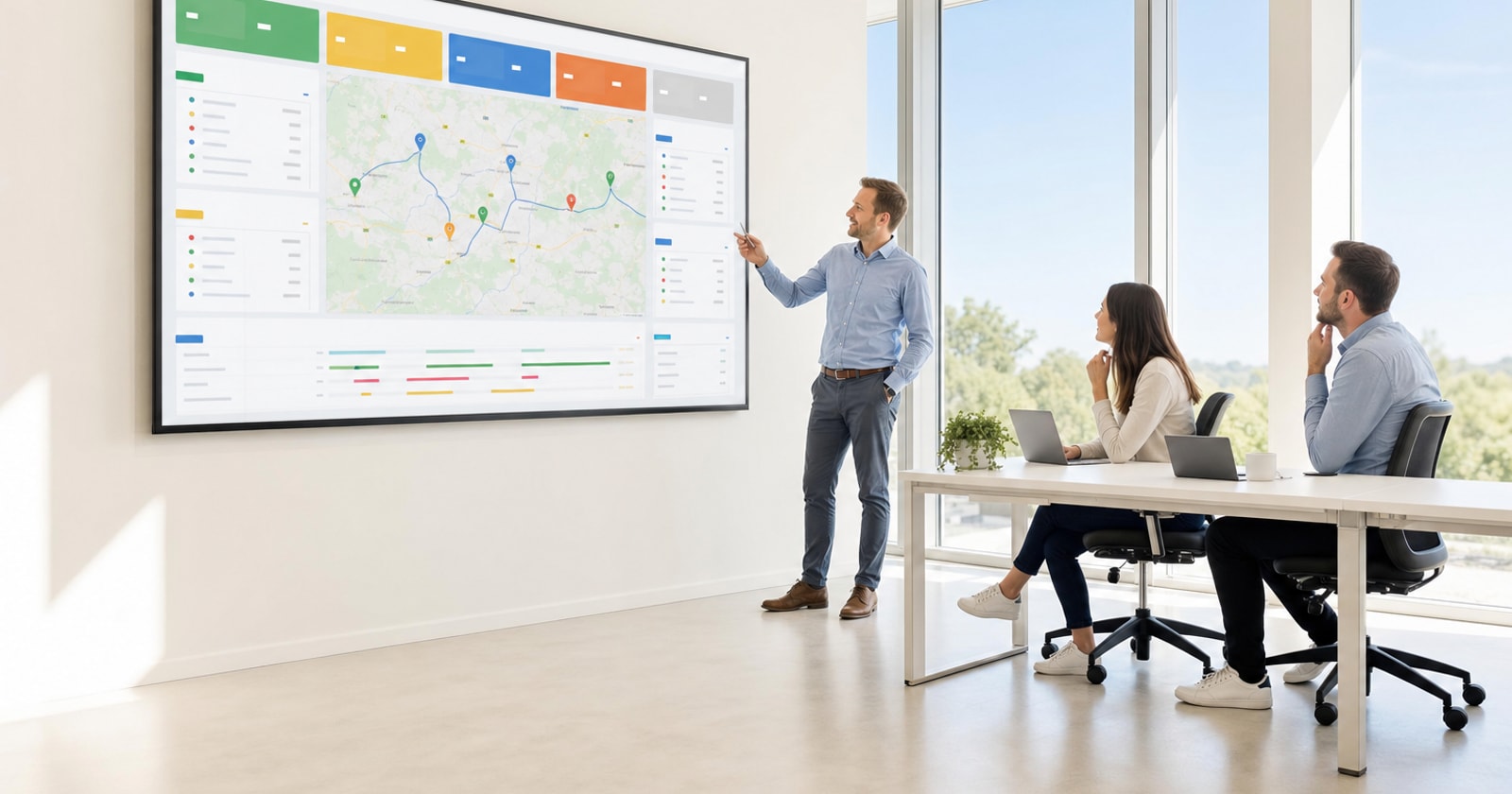
The owner can actually look at the business instead of into it. Cross functional dashboards that pull from real operational data, not exports, not spreadsheets, not memory, mean the weekly ops review is a conversation about decisions, not a data reconciliation exercise.
This is what PolarPath is built to do: own the operational execution layer from the first customer intake through quote, field work, project management, invoicing, and workforce, working alongside QuickBooks rather than replacing it. The accounting stays in QuickBooks. The operational truth lives in PolarPath. Each system does what it is actually good at.
Before You Walk Away: One Practical Step
If your operation has more than 20 people and you still feel like you're playing telephone between departments, the highest leverage thing you can do right now is not buy software. It is to pick your three worst handoff points (use the framework above) and write down exactly what breaks there and what it costs in time or unbilled dollars.
That exercise does two things. First, it gives you a real number to work with, which sharpens any software conversation you have later. Second, it often reveals that the problem is more concentrated than it feels, two or three specific friction points generating most of the noise.
Once you know those two or three points, you can evaluate any platform (including this one) based on whether it actually solves them, not based on a feature checklist.
The Bottom Line
Operational continuity is not a feature. It is a design principle. Either your business is built so that information flows automatically from one function to the next, or it is built so that humans carry it between systems manually. The second model works fine up to a point. Past that point, it gets expensive in ways that are easy to miss quarter by quarter and hard to miss at year end.
If you want to see what the first model looks like inside a shop like yours, mixed service and project work, QuickBooks already in place, a real team in the field, the clearest thing to do is walk through it with someone who runs it every day.
That conversation starts at polarpath.ca.