

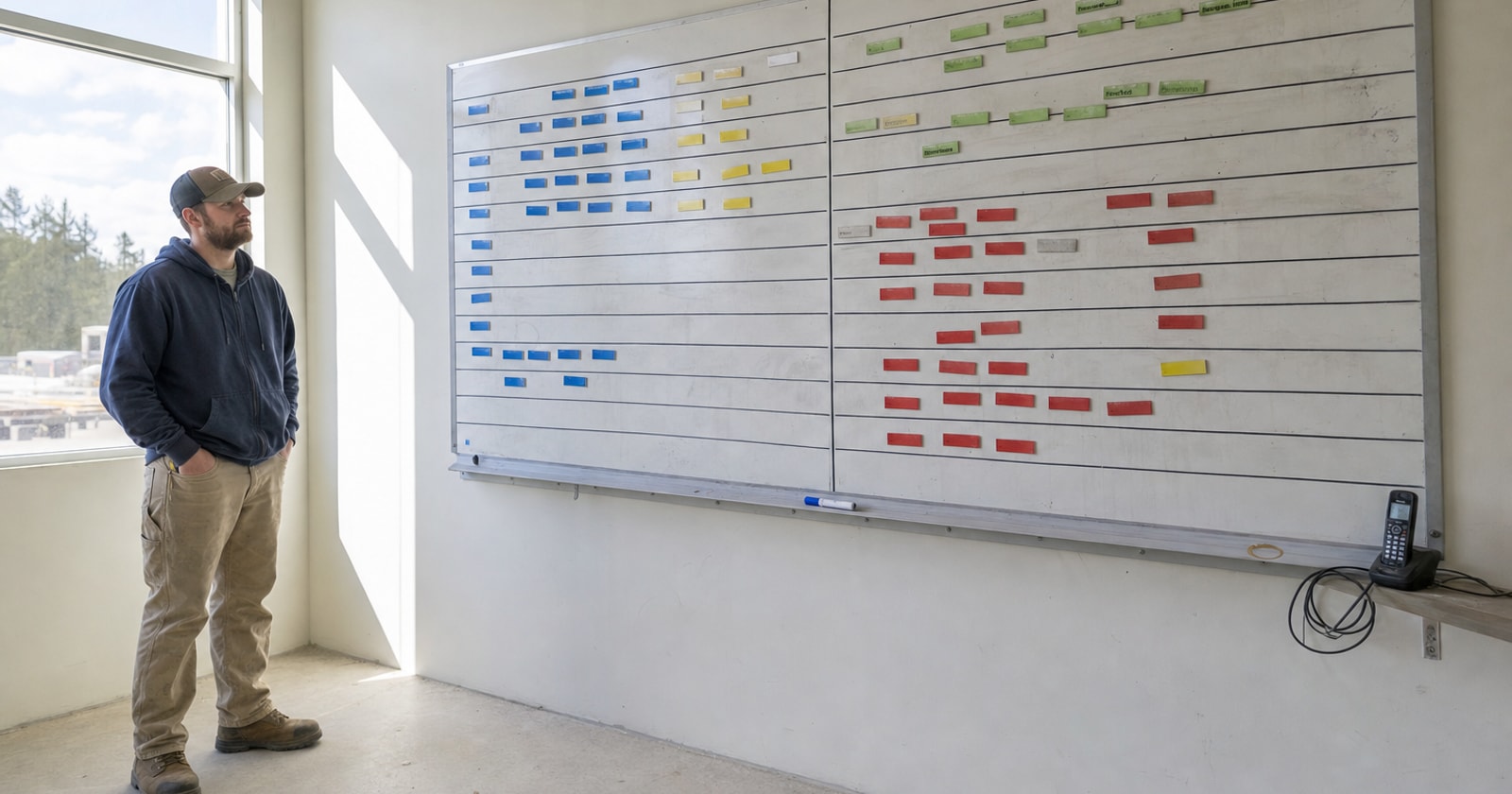
The dispatcher phones the PM to ask who is actually free today. The PM checks a whiteboard, a spreadsheet, or a group chat. The dispatcher waits. A customer waits. And somewhere in that gap, a tech gets double booked, a service call gets pushed, or a crew shows up short on a project because someone already sent them somewhere else.
This is not a communication problem. It is a scheduling architecture problem. And it is almost universal in shops that run both reactive service calls and planned project work.
Why Mixed Model Operations Break Dispatch
Most field service businesses land in the same place eventually: they started doing service, picked up some project work, and now they run both. Good for revenue. Hard on operations.
The problem is that the tools followed the same split. Service lives in a dispatch board. Project crews live in a Gantt chart, a PM's notebook, or a separate scheduling tool. There is no single calendar where both kinds of work exist at the same time.
So when a service call comes in at 9 a.m. and the dispatcher needs a certified HVAC tech, they do not know which ones are already committed to a project site that day. They have to ask. That phone call or text is what the industry calls "human middleware", a person acting as the connection between two systems that do not talk to each other.
Human middleware is slow. It is interruptive to the PM who is already managing the project. And it is error prone, because the answer depends on whoever picks up having an accurate picture of the day in their head.
What Double Booking Actually Costs
The cost shows up in a few ways that are easy to overlook individually but add up fast:
- Unbilled or under utilized labour. A tech sent to the wrong place, or pulled off a project mid day, loses productive hours. Those hours still show up on payroll.
- Customer experience on the service side. A pushed call is a dissatisfied customer, and in the service business, repeat calls and referrals are the margin.
- Project timeline slippage. Pulling a crew member to cover a service gap delays the project. Delays eat margin on fixed price jobs.
- Dispatcher and PM time. The phone call takes two or three minutes. Multiply it across a dispatching day and you have a meaningful slice of both people's attention pulled away from higher value work.
None of these show up as a line item in your P&L. They show up as margin you cannot explain, projects that always seem to run a little long, and a dispatch team that feels like they are always putting out fires.
The Scheduling Architecture That Fixes It
The answer is not a better communication protocol. The answer is a single board where all committed time, for every technician and crew member, is visible in one place regardless of whether the work is a service call or a project assignment.
This is what PolarPath's dispatch board does.
When a tech is assigned to a project task for Tuesday, that commitment appears on the same calendar as every service call. A dispatcher scanning the day board sees the full picture: who is on project work, who is on service calls, and who has open time. No phone call to the PM. No cross referencing two systems. The board already knows, because both kinds of work sit on the same calendar.
What the Board Looks Like in Practice
Picture a colour coded day view. Service calls appear in one colour, project crew assignments in another. Each tech has a row. At a glance, the dispatcher can see:
- Which techs have committed project time and when it ends
- Which techs have open blocks that can absorb a service call
- Whether a service call's geography makes sense for a tech who is already in a certain part of the region (relevant if your crew is split between, say, a project in Vaughan and service calls coming in from Scarborough or Mississauga)
When a new service call comes in, the dispatcher does not guess. They look at the board, find a tech whose schedule actually has the opening, and dispatch. The assignment is confirmed in the system, so if the PM later looks at crew availability, they see the updated picture too.
Why This Matters More for Project Heavy Shops
Pure service businesses have always had dispatch boards. The gap appears when project work enters the picture, because project crew scheduling tends to live with the project manager and gets managed differently.
In a mixed model shop, a senior tech might be the lead on a mechanical retrofit for the first half of the week and available for service calls the second half. That kind of split availability is nearly impossible to manage across two systems without someone manually reconciling them. On one board, it is just a block of time.
A Simple Framework: Auditing Your Current Dispatch Setup
Before changing anything, it helps to measure where the friction actually is. Ask your dispatcher or ops lead these questions:
- How many times per day do you contact a PM or supervisor to confirm crew availability?
- How often does a tech end up committed to two things on the same day?
- When you look at your scheduling tool right now, can you see project assignments and service calls in the same view?
- How long does it take to confirm who is free for an urgent call?
If the answers to questions 1 and 2 are "more than once or twice" and the answer to question 3 is "no," the gap is your scheduling architecture.
The fix does not require a rethink of your whole operation. It requires that one calendar exists where all work lives, regardless of type.
Closing Thought
The dispatcher to PM phone call feels like a small inefficiency. But it is a symptom of a structural problem: your service operations and your project operations are running on separate information. Every decision made from incomplete information costs you something, whether that is a double booked tech, a delayed project, or a service customer who waited too long.
For shops running both kinds of work, PolarPath's dispatch board is built specifically for this: one view where service calls and project crew assignments share the same timeline, so availability is visible without anyone having to ask. If your dispatcher still has to make that phone call every morning, that is the clearest sign the architecture needs to change.