

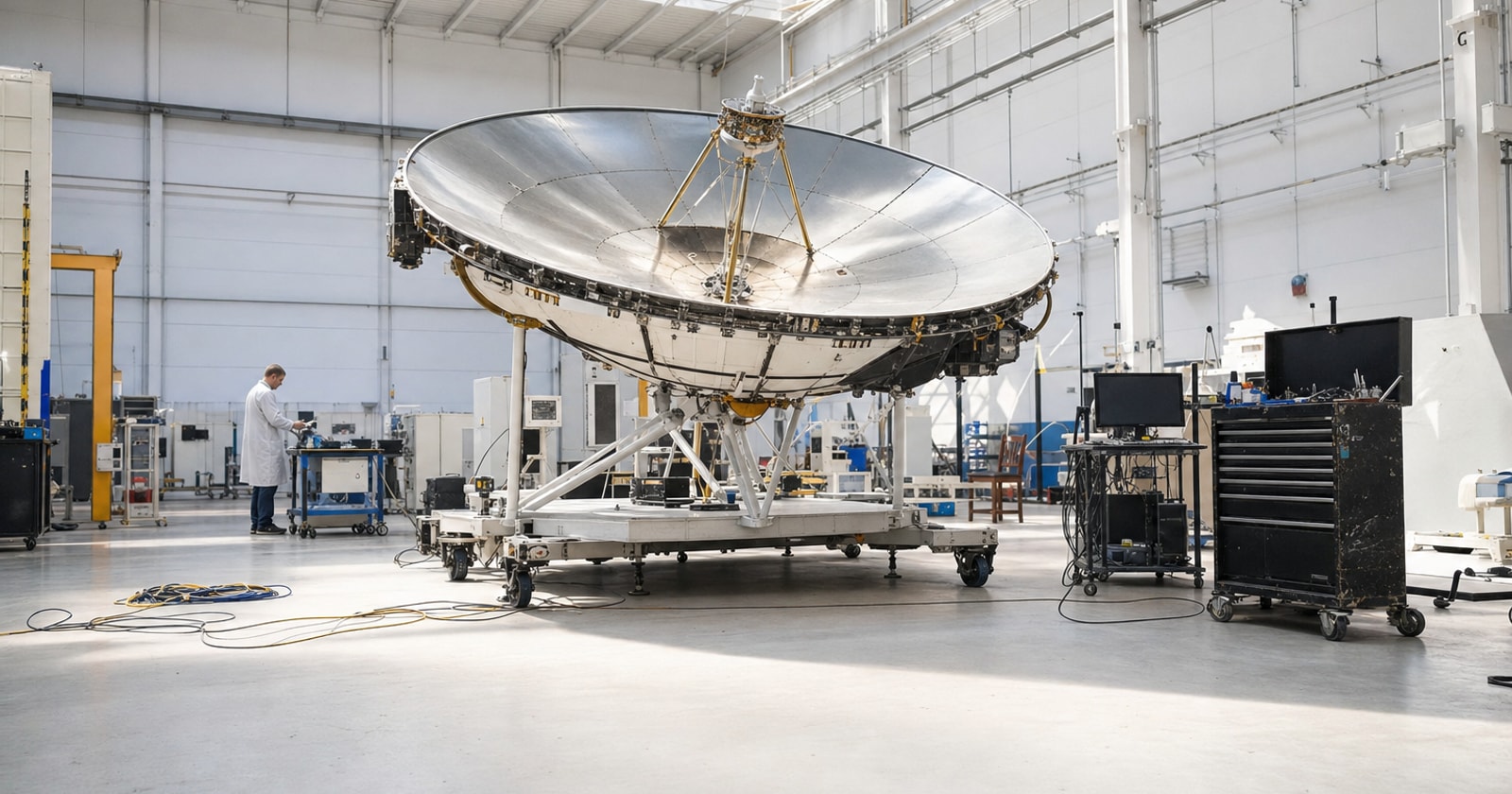
A $420 Million Bet on AI Everywhere
Last week, Starcloud closed a $250 million extension to its March 2026 Series A, bringing its total raise to $420 million and valuing the company at $2.3 billion. Starcloud is building satellites that don't just relay data, they run AI inference directly in orbit. Their next spacecraft, Starcloud 3, is slated to launch aboard SpaceX's Starship and will serve as a full orbital data center.
The headline feels distant from a service contractor running HVAC installs in Mississauga or managing mechanical projects across the GTA. But the infrastructure story underneath it is directly relevant to how field service and project operations software will evolve over the next three to five years.
Why "AI Inference at the Edge" Is the Operational Story Here
Most of the AI capability contractors have access to today runs in centralized cloud data centers. When a dispatcher queries an AI scheduler, a field tech submits a voice note for a daily report, or an AI agent screens a job applicant, that request travels to a server farm, gets processed, and comes back. Latency is usually fine. But coverage and reliability can be inconsistent, especially for crews working on remote sites, inside large facilities with poor cell signal, or in areas underserved by terrestrial infrastructure.
Orbital compute changes the geometry of where AI lives. Instead of routing through a few centralized points, inference can happen at lower latency from a node that has line of sight to virtually any location on the surface. As more satellites like Starcloud 3 come online, and as the launch market grows more competitive, which is part of why Starcloud's CEO moved to lock in SpaceX capacity early, the cost of distributing AI compute globally will fall.
For field service software, that means:
- AI scheduling and dispatch logic can run with fewer connectivity dependencies for field teams on remote or low signal sites.
- On site intelligence (think: AI reading a photo of a panel, a rooftop unit, or a job site condition and flagging a risk) becomes more viable in locations that currently have unreliable connectivity.
- Always on AI agents (for customer intake, appointment scheduling, or subcontractor coordination) become more resilient as the underlying infrastructure becomes more distributed.
None of this is happening next quarter. But the capital flowing into orbital compute infrastructure is a reliable leading indicator that low latency, high availability AI capability is on a path toward commodity pricing.
What Contractors Should Actually Be Thinking About Now
The mistake most operators make with technology shifts like this is waiting until the capability is table stakes before paying attention. By then, the competitors who adapted early have already built process habits around it.
Here is a more practical way to think about where AI in field operations is headed, and what to prioritize:
1. Identify where your real bottlenecks are today
Orbital data centers will not fix a dispatch board that lives in someone's head, or a change order process that depends on a PM remembering to follow up. Before AI infrastructure matters to you, your operational data needs to flow cleanly in one place. If your job data, field notes, and billing are in three different systems, AI has nothing useful to work with.
The first question is not "what AI tools should we adopt?" It is: "do we have a single source of operational truth?"
2. Understand what AI in field operations actually does well right now
Today's AI is reliable for:
- Screening and ranking job applicants against specific role criteria (fit score, recommendation, written summary of strengths and concerns).
- Handling inbound customer contacts outside business hours (intake, scheduling, basic qualification).
- Summarizing field data into structured outputs (daily reports, inspection notes, job completion summaries).
- Flagging margin and billing gaps across a project portfolio.
It is less reliable for: replacing the judgment of an experienced dispatcher, reading complex site conditions without good data inputs, or predicting demand with sparse historical records.
Match the tool to the actual task.
3. Think about connectivity as a real operational constraint
For contractors running crews in underground parkades, inside large institutional buildings, or on remote industrial sites, connectivity is already a daily friction point. When evaluating field service platforms, ask specifically how they handle offline first field execution: can a tech complete a work order, capture photos, and submit a timesheet without a live connection, with the data syncing when signal returns? That question is worth asking now, before the AI features in the platform become more connectivity dependent.
4. Avoid point tool proliferation in the name of "AI adoption"
The AI tool market is crowded and moving fast. The temptation is to stack new AI point tools on top of an already fragmented operation. That just adds another handoff for a human to manage. The better path is a platform where AI capabilities are built into the workflow you already run, scheduling, dispatch, quoting, field execution, invoicing, hiring, so the intelligence surfaces where the work actually happens.
What the Starcloud Story Is Really Telling You
Starcloud raising $420 million to put AI inference in orbit is not a space story. It is an infrastructure story. The people building it are betting that demand for real time, distributed AI compute will outpace what terrestrial data centers can cost effectively deliver. That demand is coming from industries exactly like field service: operationally complex, geographically dispersed, increasingly dependent on AI for scheduling, routing, and job site intelligence.
The practical implication for a contractor running a mixed service and project business: the AI capabilities that feel cutting edge today will be baseline expectations in your software within a few years. The question is whether your operational foundation is ready to take advantage of them when they arrive.
That means clean data. Single system workflows. Field execution that connects back to billing and project margin without a human re keying anything in between.
The Short Version
You do not need to understand orbital mechanics to act on this story. What you need to know is that the infrastructure enabling always on, low latency AI for operational software is being built right now, at significant scale. Contractors who have already consolidated their workflows into a single operational platform will absorb those capabilities naturally. Contractors still running on fragmented tools will be playing catch up.
PolarPath was built for the mixed model operator who needs that single operational layer, from customer intake through to invoicing and workforce management, working alongside QuickBooks rather than replacing it. If the Starcloud story prompts you to think seriously about where your operation stands today, that conversation is worth having. Start at polarpath.ca.