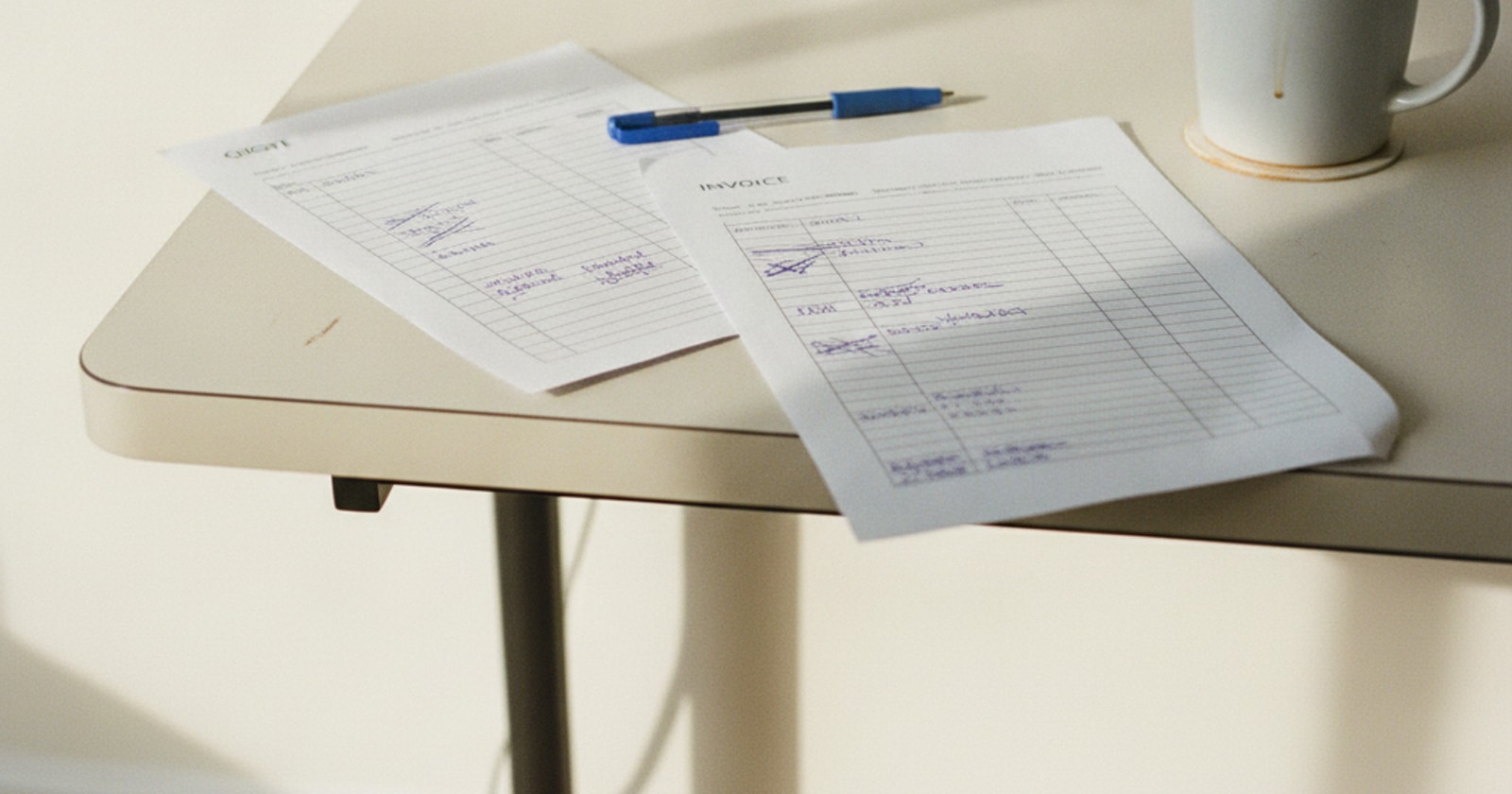
Your office copies prices and item details from a quote into a job sheet, then types them again on the invoice. If that sentence describes your shop, you are not behind, that is simply how most field service and trade businesses run today. But it is worth understanding exactly what that re entry costs before you decide it is just the price of doing business.
Why Triple Entry Happens in the First Place
A contractor's workflow touches at least three documents before a job gets paid:
- The quote or proposal, built to win the work
- The work order or job sheet, used to execute the work
- The invoice, used to get paid for the work
In most shops these three documents live in three different places. The quote might be a PDF built in a spreadsheet or a quoting tool. The work order is a form in your dispatch system, or still a paper sheet on a clipboard. The invoice is built in QuickBooks after the fact.
Nobody designed it that way deliberately. It grew up over time as the business added tools to solve individual problems. The result is that the same line items, the labour rate, the material cost, the scope description, get typed, copied, or re keyed at least twice after the original quote is created.
What That Re Entry Actually Costs You
The obvious cost is time. Someone in your office spends real minutes on every job transferring information that already exists somewhere else.
The less obvious costs are more damaging:
Transcription errors. When a person copies a number manually, mistakes happen. A labour rate gets transposed. A material line gets left off the work order. The wrong revision of the quote gets used. These errors are hard to catch because nobody is comparing the documents side by side, they trust the copy is accurate.
Unbilled work. The most common version of this: a line item is on the quote but gets dropped when someone builds the invoice from memory or from a job sheet that was never fully updated. That work was done. It was priced. It just never got billed. For a shop doing dozens of jobs a month, this adds up to real margin loss that never shows up as a single visible mistake, it just quietly disappears.
Invoicing lag. When the invoice depends on someone in the office manually reconciling the job sheet against the original quote, it waits. The job is done on Tuesday. The invoice goes out Thursday, or Friday, or the following Monday. Every extra day is a day your cash is sitting in a client's account instead of yours.
Wrong version risk. Quotes go through revisions. If the work order and invoice are built manually from an earlier draft, the crew executes one scope and the invoice bills a different one. Now you have a dispute.
A Simple Framework: Trace the Line Item
Here is a practical audit you can run on your own process right now, without any software changes.
Pick any five recently completed jobs. For each one, pull three documents: the final approved quote, the work order the crew used, and the invoice you sent.
For each job, ask:
- Do the line items on the work order match the approved quote exactly?
- Do the line items on the invoice match the work order?
- If they differ, what changed and was it captured intentionally (a change order, a scope reduction) or accidentally (someone missed a line)?
Most shops that run this audit find at least one discrepancy per job. Some find that entire line items are routinely dropped between quote and invoice. That gap is the cost of manual re entry made visible.
If you find consistent gaps, you have a process problem, not a people problem. The system is making errors easy and accuracy hard.
What "Build It Once" Actually Means in Practice
The alternative to re entry is a connected workflow where the quote is the starting point for everything downstream.
When a quote is approved, its line items, the labour, the materials, the scope descriptions, the prices, carry directly into the work order. The crew sees the same scope the client approved. When the job is done, those same items flow into the invoice. Nobody transcribes anything.
The practical effect:
- The work order reflects what was actually sold, not what someone remembered.
- The invoice reflects what was actually on the work order, not what someone reconstructed.
- If the scope changes mid job, the change order updates the record and that update carries through, it does not get lost between documents.
This is what PolarPath's quotes and proposals module does. Your office builds the quote once. When the client approves it, its items carry into the job and into the invoice without being retyped. The same line items that appear on the quote appear on the work order the crew works from and on the invoice the client receives. There is no parallel entry and no reconciliation step.
PolarPath sits on top of QuickBooks rather than replacing it, the invoice that flows from the approved quote still syncs to your books. The accounting side does not change. The re entry does.
Practical Takeaway
If you run the five job audit above and find consistent gaps between your quotes, work orders, and invoices, that is the problem to fix first, before dispatch software, before scheduling optimization, before anything else. Accuracy at the quote stage is only valuable if it carries all the way to the invoice.
The question to ask about any tool or process change is simple: does the approved quote automatically become the work order and the invoice, or does someone still have to copy it?
If the answer is still "someone copies it," you are paying for the same information three times.
Curious how this would work for your shop? See how PolarPath fits your operation at polarpath.ca.